THEATER HISTORY

Even in the heyday of elaborate movie palaces, the Fox stood out.

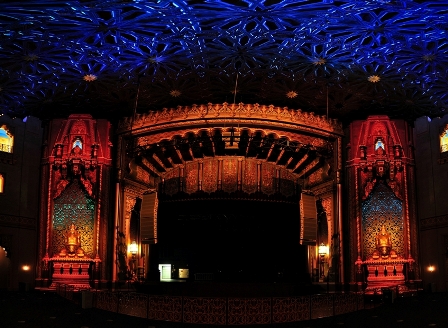
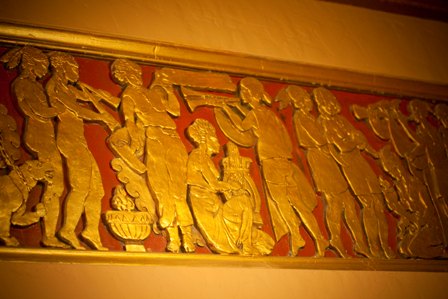
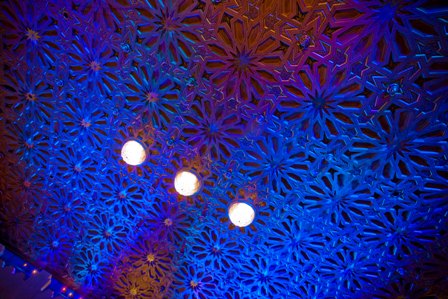
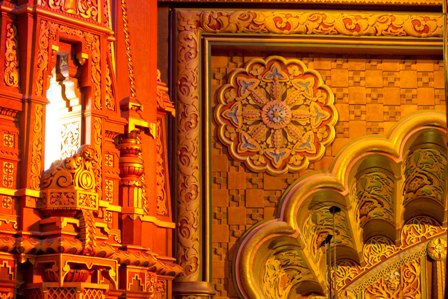
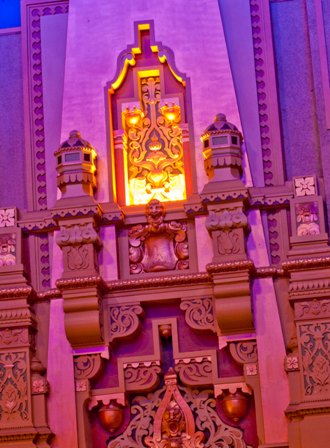
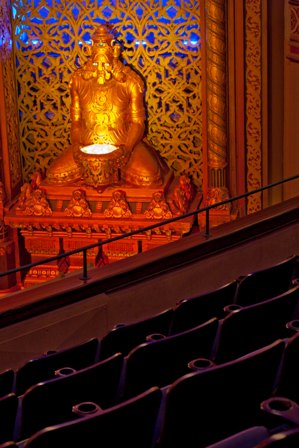
When the Fox Theater opened its doors in October 1928, 20,000 patrons thronged Oakland's newest movie palace to experience music on the Mighty Wurlitzer, a live stage show and one of the latest innovations, the "talkies" that were replacing silent films. But one of the biggest draws was the massive domed theater itself, an opulent and exotic mix of terra cotta tiles, dizzyingly detailed paintings and golden deities, reminiscent of a Brahmin Temple.

Even in the heyday of elaborate movie palaces, the Fox stood out. The architecture of the buff brick and terra cotta structure has long defied definition; being variously described as Indian, Moorish, Medieval and Baghdadian. At the time, the San Francisco Chronicle called it "different, novel and mystic," noting "its spaciousness, luxurious appointments and beautiful designs." Rich colors and gold leaf were abundant, including two bejeweled golden figures flanking the stage who were quickly dubbed Buddhas, though historians now believe they were designed as warriors.

For more than three decades, the Fox held its own as a first-run movie house in a bustling downtown entertainment and shopping district. But as the advent of television dealt a blow to the movie business and suburban malls and multiplexes began to lure people away from downtowns in cities nationwide, Oakland was no exception.

The Fox closed its doors in 1966. Downtown lost its theaters, its department stores and much of its vitality. The grand Fox, closed longer than it was ever open, escaped the wrecking ball more than once, but suffered fires, leaky roofs, decay and graffiti.

The Fox survived an arson fire in 1973, but its increasingly shabby condition led it to be derided as "the largest outdoor urinal in the world." Still, the theater escaped an attempt to raze it for a parking lot in 1975 and was named a city landmark in 1978.

That same year, Piedmont residents Erma and Mario DeLucchi bought the property at auction for $340,000 in hopes of restoring it and saving it from the fate of San Francisco's Fox Theater, which had been demolished in 1963. The couple had gone on Saturday night dates at the Oakland Fox as high school sweethearts in the early 1930s, Erma wearing the gardenia corsages Mario would bring her.

"We just loved it. It was luxurious and it was always a good movie," recalled Erma DeLucchi, an Oakland native. But Mario died soon after they bought the theater, and the project never got under way.

In 1996, the city, under the leadership of Mayor Elihu Harris, bought the building from Erma DeLucchi for $3 million. But still, nothing happened. After the wet El Niño winter of 1997-98, preservationists began pressuring the city to repair the Fox's roofs. Parts of the intricately painted walls and ceilings had been damaged by rain, and mushrooms were sprouting from the floor.

The Oakland native Phil Tagami, whose parents had their first date at the Fox Theater, had first approached city officials about restoring the theater soon after the city purchased it in 1996. "I felt laughed at," recalled Tagami, 42, a high school dropout who cut his teeth working as a laborer in the construction business before starting to buy and fix up old buildings, mostly in downtown Oakland.

But Tagami earned a good measure of credibility for restoring the former Kahn's department store across from City Hall — a long-shuttered but stunning piece of Beaux Arts architecture with its soaring glass dome — into the Rotunda office and retail building. Soon after the Rotunda opened, and the Fox sign was relit, an editorial in the Oakland Tribune urged someone to tackle the Fox. It suggested Tagami. Impatient with the glacial progress on the Fox to date, Tagami organized a meeting of interested parties and then took another plan to the city.

Tagami began searching for additional funding, leading to a complex financing and ownership structure that combines city redevelopment money with grants, tax credits and even billboard revenue. Years in the making, the project has gone through 28 public hearings, plus another three dozen meetings on community outreach and local hiring for construction.

Finally, after over 40 silent years, the Fox Theater will re-open its doors as a live music venue, arts school, and restaurant - its aged and rain-damaged interior restored to its once-breathtaking beauty. The theater's opening finally will anchor the long-awaited renaissance of an Uptown entertainment district of theaters, restaurants, and nightspots.

HISTORIC EVALUATION

The Historic Resource Evaluation, prepared January 4th, 2001 by Alan R. Dreyfuss, Architect AIA, is the definitive report on the Fox Oakland Theater. The evaluation was developed from a field investigation that included an examination of all accessible areas of the exterior and interior. Existing plans, historic photographs and other supporting material were also reviewed. The field observations encountered were compared to the plans and other available information to determine the date of construction and condition of the various elements and spaces that constitute the building.

CHRONOLOGY

1926

On Sept. 21 the Oakland Tribune reported that "Oakland is to have two new motion picture theaters in the downtown district increasing the assessed valuation of the city by four million dollars or more... ." One theater, to be located on Telegraph Avenue, would be operated by West Coast theaters; the other, at an undisclosed downtown location, was to be operated under the Publix banners... ." The former opened on Oct. 27, 1928 as the Oakland (soon to become the Fox Oakland) and the latter finally opened as the Paramount, two blocks away on Broadway, on Dec. 16, 1931. Both are still standing. The Paramount was restored in 1973 and today is home to the both Oakland East Bay Symphony and the Oakland Ballet. The Fox Oakland's restoration began slowly in 2000.

During 1926 in the city of Oakland, five new theaters were completed and opened for business

1927

On May 15 The East Bay Builder ran a story entitled "Oakland's Largest Theatre Starts Construction" and the following month the Oakland Outlook reported that "rapid progress is being made by the builders." Both articles included the same line drawing of the exterior, showing the name of the theater as the "Bagdad" [sic] and said that interior decoration was of Indian origin.

During 1927 the Oakland Municipal Airport was established with construction of a 7,020-foot runway and the first trans-Pacific flights from North America to Hawaii. On Sept. 17 Charles A. Lindberg dedicated the new airport.

1928

On May 31 the Rudolph Wurlitzer Co. of Cincinnati, Ohio shipped a three-manual 15-rank Wurlitzer pipe organ (opus 1960) from its factory to a new theater under construction in Oakland, CA. The new Oakland Theater opened its doors to the public at 11:30 a.m. on Saturday, Oct. 27, 1928, becoming the 251st theater in the West Coast Theater chain. A staff of 150 ran the Oakland, with weekly operating costs of $20,000. For a detailed account of opening day, including a description of the inaugural program and newspaper reviews from both the San Francisco Chronicle and the Oakland Tribune, please visit our 1928 OPENING DAY page.

One hour after Mayor John L. Davie dedicated the new Oakland Theater, he participated in ceremonies to officially open the Posey Tube, the new underwater automobile tunnel connecting the cities of Oakland and Alameda.
1929

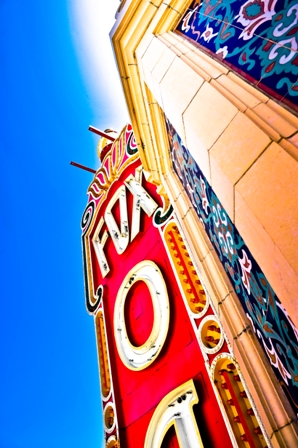
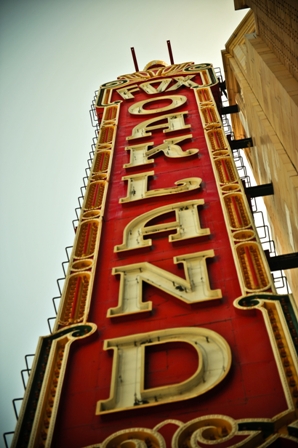
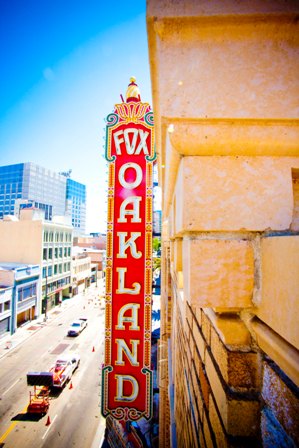
During March, in Oakland Tribune advertisements, the theater's name changed from the "Oakland" or occasionally the "West Coast Oakland" to the "Fox Oakland" or "Fox-Oakland." By October letters at the top of the vertical blade sign had been changed from "West Coast" to "Fox." For many years the Fox West Coast Theater chain owned and operated not only the Fox Oakland, but also the Orpheum, the T&D, the Grand Lake, and the Paramount theaters.

On May 16 the first Academy Awards ceremony was held in the Blossom Room of the Hollywood Roosevelt Hotel. During October, the bottom fell out of the stock market and the Great Depression began.

1931

The following article was printed in the Observer on Oct. 17, 1931:

The Fox Oakland Theatre's Third Anniversary
The Fox Oakland Theatre is celebrating its third birthday with a gala show on screen and stage this week.

Frank R. Newman, formerly of Long Beach, California, who has been manager of the Fox Oakland since its opening, has assembled some interesting figures gathered over a three year period, which show that more than six million persons have passed through the doors of the theatre since its opening matinee in October, 1928. One million, five hundred thousand have attended matinee performances and the remaining four million, five hundred thousand, evening performances. Two hundred thousand children have been in attendance.
Eighty-five percent of the matinee attendance has been women, and an interesting fact relating to the privilege of changing one's mind, shows that in three years, 11,000 persons have purchased general admission tickets and later returned them for loge seats. An upward trend in the purchase of loge seats which is attributed to the smoking privilege in this section shows that 700,000 persons have purchased loge tickets.

Fox Oakland employees have received over $1 million in salaries in three years, and 5,000 actors have appeared on the stage. Newman also figures that each actor visiting Oakland spends an average of $30 a week in Oakland hotels and restaurants, which makes a total of $150,000 spent here by outsiders brought to this city through the theatre.
Saturday midnight shows introduced to Oakland by the Fox Oakland Theatre have entertained more than 500,000 people, and at the present time are Oakland's only after-midnight entertainments.

As master of ceremonies at the Fox Oakland Theatre, Hermie King has set a country-wide record by appearing here 125 out of the 156 weeks that the theatre has been open. The entire stage crew, five projectionists, and many of the house staff including D.P. Isabella, assistant manager, and Velma Ireland, head usherette, have been in the employ of the Fox Oakland since its opening.

A.M. Bowles, northern California division manager for Fox West Coast Theatres, recently stated that the Fox Oakland was second only to the Fox Theatre in San Francisco for consistent popularity and stated that the best in talking pictures along with Franchon and Marco Stage Ideas would continue to be the policy at the Fox Oakland. The anniversary week program is headed by the Four Marx Brothers in their new comedy, "Monkey Business."

On Dec. 16 the nearby Paramount Theatre opened its doors one year and four days after its groundbreaking ceremony. Within six months, however, the theater closed for almost a year because it was unable to pay operating costs of more than $27,000 per week. A new manager eventually reduced overhead by dimming many of the lights and eliminating the orchestra, the stage crew, and live performers.

1935

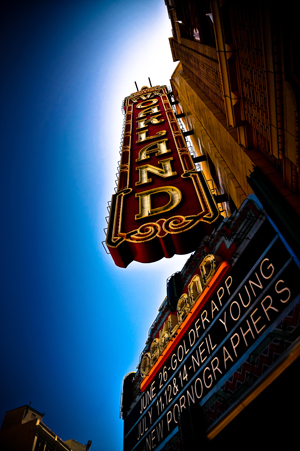
The Fox Oakland Theater's rectangular marquee was removed and replaced by a new marquee with angled sides, which was rehabilitated in 2001.

If you have personal memories, photographs, or memorabilia of this remodeling project, we'd love to hear your story. Please email FOOF.

1941 - 1945

During March, in Oakland Tribune advertisements, the theater's name changed from the "Oakland" or occasionally the "West Coast Oakland" to the "Fox Oakland" or "Fox-Oakland." By October letters at the top of the vertical blade sign had been changed from "West Coast" to "Fox." For many years the Fox West Coast Theater chain owned and operated not only the Fox Oakland, but also the Orpheum, the T&D, the Grand Lake, and the Paramount theaters.

Executive Order 9066, signed by President Franklin Delano Roosevelt on Feb. 19, 1942, authorized military commanders to prescribe military areas "from which any or all persons may be excluded"; this eventually led to the exclusion of more than 100,000 Japanese and Japanese Americans from Western costal regions and their relocation to internment camps away from the coast. In September President Roosevelt visited Oakland to inspect military installations, shipyards, and factories. Paul Robeson, actor and singer, entertained the workers at Moore Dry Dock Company on Sept. 20, 1942.
1946

On Jan.11 the Oakland Tribune's Wood Soanes reported that the movie "'Spellbound,' long awaited by the clienteles of Ingrid Bergman, Alfred Hitchcock and, to a lesser degree, Gregory Peck finally arrived on the screen of the Fox-Oakland yesterday which, by the way, is in the throes of redecoration and rehabilitation... ." The remodeling included adding a stainless steel surface to the exterior entry walls, installing a cloud ceiling beneath the marquee, and moving and redesigning the ticket booth. Part of the lobby was remodeled, closing off its dome to insert 2nd and 3rd floor hallways connecting the two office wings. The lobby's Maynard Dixon mural, "The Goddess of Fire," on the upper wall opposite the main entrance, was apparently covered or removed at this time.

If you know the fate of "The Goddess of Fire" or have other personal memories, photographs, or memorabilia of the Fox Oakland Theater, we'd love to hear your story. Please email FOOF.

1960

Fox West Coast Theaters sold off the unused organs in many of its theaters. The Fox Oakland's Wurlitzer (opus 1980) was sold to a contractor, Jon Leininger, who had worked for the theater chain. Mr. Leininger designed and built a large, rustic home in the small northern California town of Shingletown (near Redding, CA) to house the mighty Wurlitzer, where it remains today.

If you have personal memories, photographs, or memorabilia of this Wurlitzer organ (opus 1980), we'd love to hear your story. Please email FOOF.

1962

As attendance was declining at grand movie palaces throughout the country, the Fox Oakland tried several options. In October it stopped showing first run movies and, for a few months, tried soft core, showing movies such as "Paradisio," (for "broad-minded adults only") "The Bellboy and the Playgirls," "Wild for Kicks," "Blaze Starr Goes Nudist," and Brigit Bardot in "Naughty Girl."

As the future of the Fox Oakland Theater grew cloudy, the fate of the Fox Theater in San Francisco became clear. In March, after S.F. voters had rejected a bond measure to buy the Fox, the San Francisco Chronicle reported, "Peter J. Sparos, speaking for the owners ..., declared that the Market Street theater would be razed." The following year as predicted, the 4,600-seat theater was demolished and replaced by an office building.

1965

On Sept. 14 the Fox Oakland Theater closed "'temporarily' because of a shortage of first-run films." According to the San Francisco Chronicle, "The movie ... which will be shown on the Fox Oakland's last day is the Marlon Brando spy melodrama, 'Morituri.' The title, appropriately, comes from the cry of the Roman gladiators: 'We who are about to die salute you.'" Thirty-five employees received termination notices. During the next seven years the theater opened sporadically for movies and special events, but never found a market that could support the required overhead and maintenance.

A year after the Fox Oakland's "temporary" closing, the Black Panther Party for Self Defense was founded in Oakland by Huey P. Newton and Bobby Seale.

1970

The Paramount Theater closed its doors after showing its last paid-attendance movie, the Beatle's film "Let It Be," on Sept. 15.

1973

At 2 a.m. on August 10, a passing taxi driver spotted flames coming from the Fox Oakland Theater and summoned the Fire Department, which immediately sent out a second alarm. According to the Oakland Tribune, "Gasoline had been spotted throughout the interior of the building, [Assistant Fire Chief Renzo] Balassi said, and separate fires were burning on the stage, among the seats on the lower floor, and in the balcony. In addition some variety of acid had been thrown over the carpeting, he said, and a control panel for the theater's lights and mechanical devices had been torn up... . The theater's owner, Edward Berkovich, and the Youth Development Corp. [a spin-off organization of the poverty war] entered into a leasing agreement recently, according to Henry F. Mozell, director of the corporation. YDC was to host movies and other community programs at the theater, splitting both the costs and the profits with Berkovich, Mozell said." The fire was obviously an act of arson and it's a great stroke of luck that the entire facility didn't go up in smoke.

Ironically, in this same year, the nearby Paramount Theater reopened with great fanfare on Sept. 22, as the new home of the Oakland Symphony.

1975

There was serious talk of tearing the Fox down to create a parking lot. The City's Public Works Department and the Off-Street Parking Commission, with support from local retailers, presented a plan for the City to purchase the property, demolish the building, and provide parking for 218 vehicles. Sheldon Milenbach of Milens Jewelry was quoted in the Montclarion saying that the Fox Oakland building is "the largest outdoor urinal in the world" and Planning Commissioner Clyde Gibbs said "The City should acquire and demolish this blighted building. It's been a blight for years." Fortunately the proposal foundered, and once again, the theater with nine-lives somehow averted disaster.

The Golden State Warriors defeated the Washington Bullets in a four-game sweep to win the National Basketball Association Championship.

1978

In January, with the strong backing of Mayor Lionel J. Wilson, the Oakland Landmarks Preservation Advisory Board began the process of declaring the Fox Oakland Theater Building a city landmark. In a letter to the Board, the Mayor wrote that he was especially pleased to see the "grass roots" support for preserving such city landmarks. On March 28 the process was completed and the Fox Oakland became the city's 23rd landmark when the City Council approved Ordinance No. 9593 C.M.S. In February of the following year, the property was listed on the National Register of Historic Places.

On Jan. 24 the Mann Theater Group sold the theater at auction. The buyers were Erma DeLucchi, the Mario Delucchi trust and Diane & Neil B. Goodhue. Erma, whose husband, Mario, had courted her at the Fox Oakland remembers, "He and I were so upset about the Fox in San Francisco," said DeLucchi, referring to the 4,600-seat giant that was demolished in 1963. "We didn't want that to happen here." The auction was held in one of the Fox Oakland Building's upstairs offices. Mr. DeLucchi had a hard time finding parking, so "he told me to just run in and see what was going on," said DeLucchi. While Mr. DeLucchi backed the car into a tight space, Mrs. DeLucchi was confidently bidding. The couple had agreed to $300,000 limit and she "only" went over by $40,000. A few months after the purchase, Mr. DeLucchi died of a heart attack. After that, "I lost heart in the project," said DeLucchi. "I just didn't have the strength to restore the Fox. I was emotionally exhausted." So the Fox Oakland sat. What had seemed a fairy tale rescue led to a Sleeping Beauty snooze.

If you have personal knowledge or memorabilia from this time period in the history of the Fox Oakland Theater, we'd love to hear from you. Please email FOOF.

1983 - 1984

The Dickens Fair used the Fox Oakland Theater during the Christmas season for two years. This was a Victorian England re-enactment with shops selling bangers and mash, and a "Tiny Tim" escorting patrons around a mock village. There were high hopes for the Fair, that using the theater year after year for a successful event would naturally evolve into the space being used for other events. But the Fair never drew as many patrons as expected. In 1984, particularly, there was one day where 80 mph winds closed down the Golden Gate Bridge and travel was therefore curbed. The Fair closed owing the city a great deal of money from a loan, and the Fox Oakland was again silent.

In 1984 following a $15 million rehabilitation, the Oakland Civic Auditorium was renamed the Henry J. Kaiser Convention Center.

1989

The 1989 Loma Prieta earthquake did almost no damage to the theater. According to Fox Oakland caretaker Herbie Taylor, "I was on the street where the telephone poles looked like fishing poles, and Mrs. DeLucchi called me to say, 'go look at the Fox'. There was one crack in the plaster and a little powder on the floor. That was it. This place could be a nuclear bomb shelter."

The Oakland Athletics defeated the San Francisco Giants four games to none in the earthquake-delayed 1989 "Bay Bridge" World Series.

1996

The city of Oakland purchased the Fox Oakland Theater Building from the Delucchis and Goodhues for $3 million.

If you have personal memories or specific information about the City's acquisition of the Fox Oakland Theater, we'd love to hear your story. Please email FOOF.

1998

Although the city purchased the building in 1996, it apparently did not realize how badly the roof was leaking or allocate funds to correct the problem until concerned members of Oakland Heritage Alliance (OHA) brought the issue to the public's attention. The winter of 1997-98 was very wet (El Niño) and, despite temporary patching, leaks in one corner of the roof were significant. In February, OHA asked the City for an opportunity to inspect the theater. After two inspection tours, several newspaper articles were published and an editorial in the Oakland Tribune noted that "the only life in the theater almost two years [after the City's acquisition] is a crop of mushrooms sprouting from the theater's soggy carpet." OHA included the Fox Oakland Theater on its 1998 Most Endangered List and noted that new "City Manager Robert Bobb has publicly expressed misgivings about the City's purchase of the Fox." However in November, redevelopment agency staff was able to report to the Landmarks Board that the "roof repair would begin soon... [and a]n enthusiastic weekend youth crew has filled 73 debris boxes to date in cleaning up the interior."

On June 11 former California governor Jerry Brown was elected mayor of Oakland with 58.9 percent of votes cast. Runner-up Ed Blakely got 14.9 percent; nine additional candidates split the remaining votes.

1999

Part way through another winter (a very dry winter, fortunately), the Fox Oakland began to get the attention it was due. The city engaged a contractor to replace the roofs, all 21 of them, and the re-roofing work took until the following January to complete.

Oakland Heritage Alliance, the citywide historic preservation organization, created a special subcommittee "to assist and influence the City's efforts to restore the Fox Oakland Theater." The subcommittee met twice a month for most of the year. Eventually the need for an entirely separate organization that could focus
exclusively on the Fox Oakland Theater became apparent, and Friendsof the Oakland Fox, Inc. was born.

2000

The San Francisco office of John Sergio Fisher and Associates, architecture, planning, and theater consultants, completed plans and specifications for restoring and repairing the 1929 blade sign, 1935 marquee, and 1946 cloud-theme ceiling beneath the marquee. In February the Oakland Landmarks Board approved the work and by [verify month] Wagner Electric Sign Company of Elyria, Ohio had begun work on the project.

The Los Angeles office of Hardy Holzman Pfeiffer Associates, architectural consultants, was hired by the city to prepare a Master Plan Report that would assist the Redevelopment Agency in reaching "its goal of restoring the Fox [Oakland] into a live performing arts complex...."

According to the U.S. Census, 399,484 residents were living in Oakland on April 1.

2001

By June, HHPA's Master Plan Report had been completed, analyzing five alternatives for the Fox Oakland Theater Building: 1. "The Basics": make minimal capital investment to achieve a limited yet useable performance hall seating 600 - 1,000; fully rehabilitate commercial wings; construct new addition at rear to increase commercial space and provide theater support functions; 2. "The Roadhouse": restore lobby to pre-1946 configuration and auditorium to 1928 grandeur with seating for about 2,550, plus "The Basics"; 3. "The Arts Center": restore lobby to pre-1946 configuration and reconfigure auditorium to provide smaller venues, plus "The Basics"; 4. "Existing Storefronts": fully rehabilitate commercial wings and façade of theater; mothball theater lobby and auditorium for restoration in future; 5. "New Storefronts": same as #4 plus construct new addition at rear to increase commercial space and provide future theater support functions.

By November, restoration of the marquee and blade sign had been completed. The City and Friends of the Oakland Fox celebrated with a "Light Up the Fox" block party featuring Mayor Jerry Brown throwing a ceremonial switch to relight the marquee and blade sign, which have remained lighted almost every night since!

Forbes magazine ranked Oakland the 10th best city for business in the U.S.  Based on U.S. Census Bureau data, the Center for Women's Business Research ranked Oakland third in the U.S. in the number of women-owned businesses.

Listed on the National Register of Historic Places, the Rotunda Building, formerly Kahn's Department Store, reopened following a $43 million renovation. The Beaux Arts masterpiece has a 125-foot atrium dome.

2002

The African American Museum and Library, a division of the Oakland Public Library, opened following an $11.2 million renovation and seismic retrofit of the former Charles Greene library building (c. 1902;. Jerry Brown was elected to a second four-year term as Mayor of Oakland; and the City celebrated the 150th anniversary of its incorporation.